
Free to share. Walkthroughs last updated: November 2026.
A Developmental Edit is the structural pass that comes after you finish your draft and before any sentence-level work. It stress-tests the pacing, worldbuilding, character arcs, and plot logic of what you actually wrote, against what you meant to write. You’ll find out what’s landing, what isn’t, and why; which scenes need more room and which need less; and what should come earlier or later.
Remember, the reader doesn’t have you there next to them to explain why something is written that way or to say, “Oh, this is what I meant.” The reader only has what is on the page and their interpretation of what you shared.
So the question is: did you share it all? Or did knowing the backstory and the plan let your brain fill in the half you never wrote down?
That’s the question I read for in a Developmental Edit. Then I write down what I found, and you get three things back: an editorial letter, an annotated manuscript, and a revision roadmap.
“Cool, thanks, Ashley. Any editor can give me any combination of those, if not all three. What makes you different?”
Well, every editor thinks differently. We sometimes catch different things, and we explain what we catch in different ways. That’s part of whether an editor works for you. I’m not going to tell you why I’m the editor for you. I can show you what you’d get, and I can show you how I’d read your manuscript with a sample edit. I may not be the right editor for you, and that’s okay. But I’d rather you find that out before you book than after, so I made a one-page walkthrough of my editorial letter and another of my revision roadmap.
Your editorial package arrives. Now what?
Read them in this order:
The editorial letter is about architecture: structure, character arc, pacing, and the story’s overall shape.
The revision roadmap is about order: what to decide, what to move, what to write, and what to hunt for—organized in rounds.
The annotated manuscript is about the page: observations tied to specific passages.
With the Letter & Roadmap Developmental Edit, you get the first two. The order is the same.
As tempting as it is, opening the annotated manuscript first is the fastest way to feel overwhelmed. (Already peeked? I get it. I’m human, and I probably would have too.) Most of what’s in there makes more sense once you have the letter’s framing.
1. The editorial letter
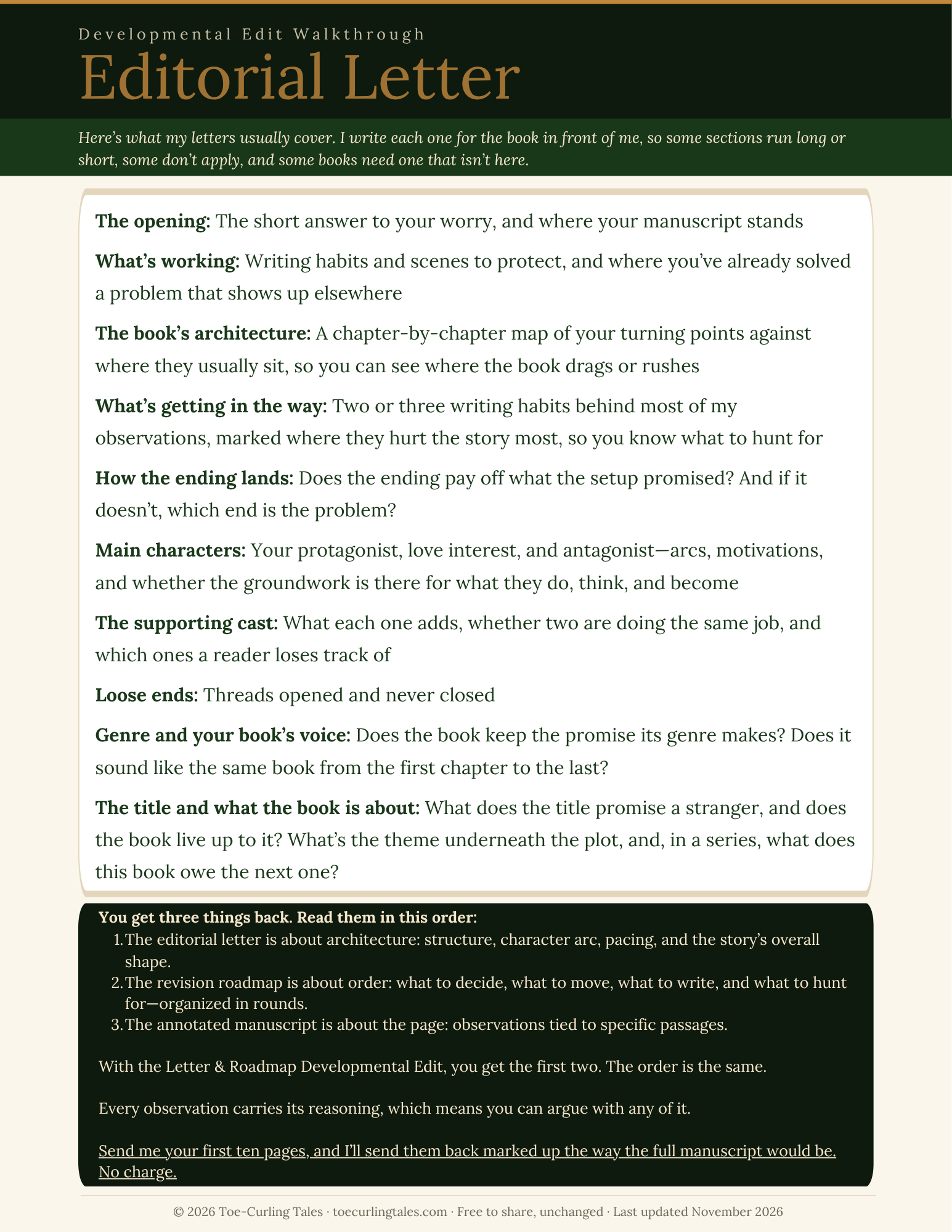
Here’s what my letters usually cover.
The opening. When you reached out to me, did you express a specific worry? If yes, I answer it here. If no, that’s okay, because “I don’t know, just read it and tell me what you see” is a perfectly fine answer. Either way, the opening tells you where your manuscript stands.
What’s working. Writing habits and scenes to protect, and where you’ve already solved a problem that shows up elsewhere (aka, you know what to do, because you’ve already shown you can do it; you might just not realize it’s the same technique another scene needs).
The book’s architecture. A chapter-by-chapter map of your turning points against where they usually sit, so you can see where the book drags or rushes. Now, I understand that no one wants their story forced into a mold. That said, most stories do share the same handful of turning points. The difference is what happens at each one, and how long it takes the reader to get there. When one of yours lands early or late, the letter asks whether that’s working for your book.
What’s getting in the way. Two or three writing habits behind most of my observations. Say you tend to explain a moment right after you’ve shown it, to make sure the reader got it. (Most writers do at some point.) That’s one habit, however often it shows up. I don’t mark every one, because that’s sentence-level work and it comes later. I mark where it hurts the story most, so you know what to hunt for everywhere else. It’s the same kind of fix each time.
How the ending lands. Does the ending pay off what the setup promised? And if it doesn’t, which end is the problem? Sometimes the ending is working, and it’s the setup that needs to change.
Main characters. Your protagonist, love interest, and antagonist: arcs, motivations, and whether the groundwork is there for what they do, think, and become.
The supporting cast. I know, I know… we love side characters. But alas, we must analyze what each one adds, whether two are doing the same job, and which ones a reader loses track of.
Loose ends. Threads opened and never closed.
Genre and your book’s voice. A genre label is a promise: call it a romance, and the reader expects the couple to end up together. Obvious, right? But did it make it onto the page, or is half of it still in your head? Then your book’s voice: how the whole thing sounds, its tone and its attitude. Does it sound like the same book from the first chapter to the last?
The title and what the book is about. What does your title promise a stranger who walks past it on a bookshelf, and does the book keep that promise? What theme comes through to someone who’s never spoken to you about it? Are you writing a series? What threads do we need to see in Book 2?
“Ashley, where’s the worldbuilding section?”
There isn’t one. I talk about the world throughout, wherever it affects the story: the magic that’s bound by rules in chapter two and free of them by the climax, because the main character is suddenly the one exception. Or the whole mess that one conversation would have cleared up fifteen chapters ago. Why couldn’t they just say something? If speaking up would cost them something in your world, I’m looking for that cost on the page.
2. The revision roadmap
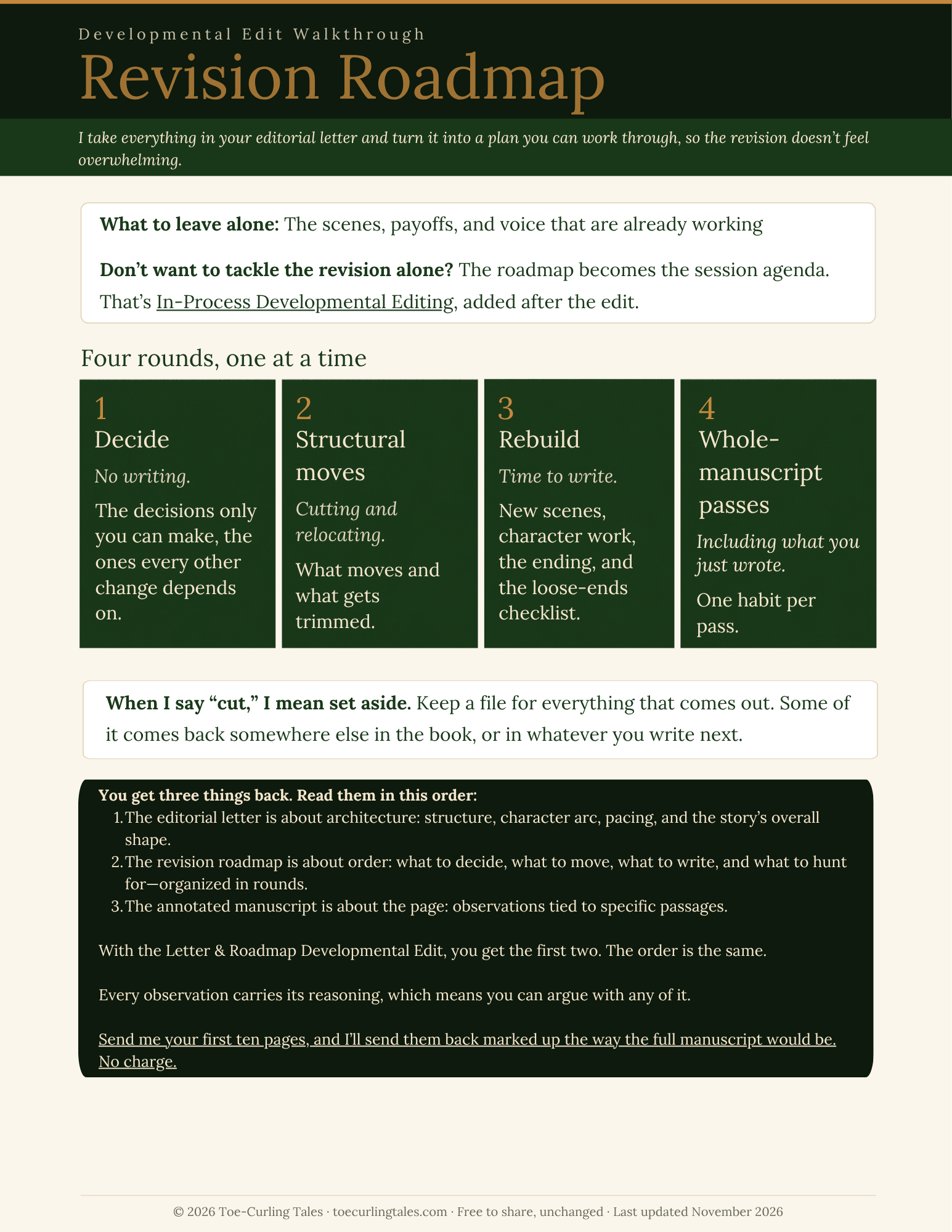
Why rounds, and why in this order? Chapters move, merge, and disappear in a structural revision. I’m trying to respect your time. The whole-manuscript passes go last for the same reason: new writing can bring back a habit you already fixed.
Round 1: Decide
No writing. These are the decisions only you can make, the ones every other change depends on. For each one, I show you the directions I can see, based on what’s on the page and what you told me you meant. I also show you what each would change in the rest of your story. You might see a direction I didn’t. It’s tempting to skip ahead to the writing and come back to these later, but one decision changes the next, and together they decide Rounds 2–4.
Round 2: Structural moves
Cutting and relocating: what moves and what gets trimmed.
When I say “cut,” I mean set aside. Keep a file for everything that comes out. Some of it comes back somewhere else in the book, or in whatever you write next—cough cough, bonus content for your readers?
Round 3: Rebuild
It is now time to write. Think: new scenes, character work, and the ending. Then tackle the loose-ends checklist if you have one.
Round 4: Whole-manuscript passes
Including what you just wrote. One habit per pass. (If you can hunt for two habits in one pass without missing either, go for it.)
Don’t want to tackle the revision alone? The roadmap becomes the session agenda, and we work through it one round at a time. That’s In-Process Developmental Editing, added after the edit.
3. The annotated manuscript
Margin notes tied to specific passages: where the page produced a reaction and what caused it, and where a technique is already working. The working passages are your model: use the same shape where a scene isn’t working yet. Some chapters also open with a note about the chapter as a whole.
With me, comment count isn’t a measure of how much is wrong. Most of what’s in the margins is an example of something the letter explains as a habit.
If you’d like to see how I read before you commit, ask for a sample edit. Send me your first ten pages, and I’ll send them back marked up the way the full manuscript would be. No charge.
“Ashley, I disagree with your assessment.”
Good. Every observation carries its reasoning, which means you can argue with any of it. You should question every piece of feedback you get, from me or anyone else. My job is to show you what each piece is doing for the story, or against it, and why. Yours is to decide whether that matches the book you’re trying to write.
It’s your story. I tell you what’s on the page and why it’s landing the way it is, so you can revise toward what you meant—or toward what the book turned out to be, which sometimes means going back and rebuilding the beginning. Never because I would have written it differently.
— Ashley