
Five Seconds at the Query Desk · A Word Count Reference
Built as a companion to the Candlelight Notes piece “What Your Manuscript Would Say from the Query Desk.” If the essay was the why, this is the at-a-glance how.
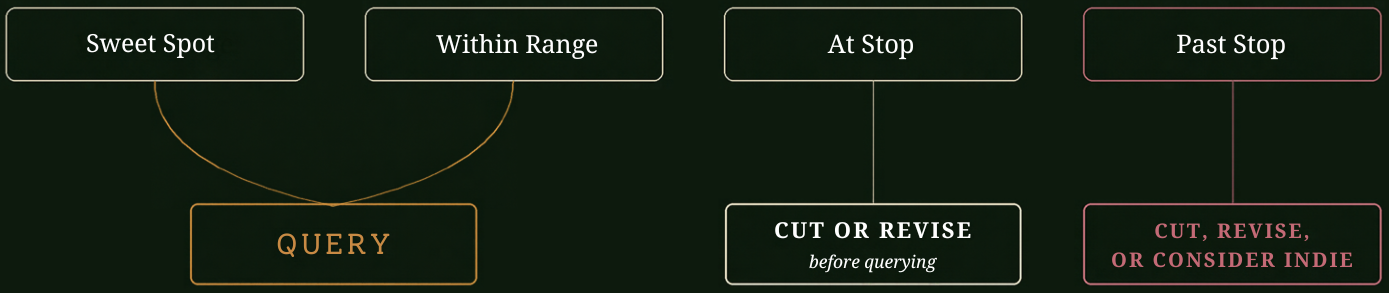
When an agent opens your query, they don’t read it top to bottom. They triage. The first thing they scan is the metadata—genre and then word count—usually in the first three to five seconds, before deciding whether to keep reading. If your word count sits outside the expected range for your genre, they have a defensible reason to pass without ever opening your sample pages.
A long manuscript from a first-time author is a harder sell, especially with production costs and shelf placement. An over-the-range word count suggests the writer doesn’t know the market, which is the easiest no an agent can make.
You might be thinking: won’t an agent or editor cut my word count in revisions if they like the book? Often, yes. Developmental editing is part of the deal once you’re in the deal, but that work starts after you get your foot in the door. The number is what gets you to the yes (or doesn’t).
Paranormal Romance
Paranormal romance carries a little more weight than straight contemporary romance, because the world has to be built.
Romantasy
Readers expect immersion, but the stop point is still real. Breakout titles at 150,000+ are written by established authors. Don’t pick them as comp titles for your debut query.
Urban Fantasy
Urban fantasy doesn’t have to build a whole new world, because it modifies this one. Shorter than secondary-world fantasy by 20K–30K, but still covers worldbuilding plus a series-launch setup.
Dark Fantasy
Epic fantasy debuts have tightened to 90K–120K, with 130K as the stop.
Numbers reflect 2026 industry guidance. Verify your specific agent’s current preferences before querying.
If your manuscript exceeds the expected range, check it against these three structural patterns first:
A subplot the climax doesn’t need. A subplot grew bigger during the writing process, and now the climax doesn’t close that loop. You loved writing those pages (and they were load-bearing in draft two), but by draft five, the story you’d built no longer needed them. The climax doesn’t reference them. The pages stayed because you remember loving them, or you forgot to remove them. The fix: cut the subplot. Your climax will hold.
A middle that drifts and drags. The opening works, the climax works, but somewhere between them (usually a five-to-eight-chapter stretch), the protagonist travels and processes. They’re not making things worse or better for themselves. They’re just living, and the reader notices. The fix: compress or merge non-escalating scenes.
Pages you wrote to figure things out. Some pages exist because you were learning the world, the characters, or the rules during early drafts. Your subconscious never went back to take that scaffolding down once the story knew itself. The pages read fine in isolation, but they aren’t doing structural work for the whole. The fix: remove the scaffolding the story no longer needs.
Over, under, or in range, every scene still has to earn its place.
Download the two-page reference. Print it, screenshot it, pin it near your manuscript, or tuck it into the folder where your query letter lives. Free to download and share.